

THE CONSUMER AI INFLECTION POINT • PART 2
Redefining how we Live, Learn & Play!
Reflections from a panel discussion on Consumer AI | Mumbai, March 2026
The frontier labs keep getting better, and a tidy conclusion writes itself: pick a vertical, wrap a capable LLM in a clean interface, and ship before someone else does. Consumer AI is a distribution game now, not a building game
The panel we hosted in Mumbai – operators from beauty commerce, emotional wellbeing, and children’s learning – kept arriving at the opposite conclusion. The model is the cheapest, most replicable part of the stack. It’s infrastructure, like electricity. What you build on top of it is the entire game.
One of them put the verdict in three words: wrappers will die.
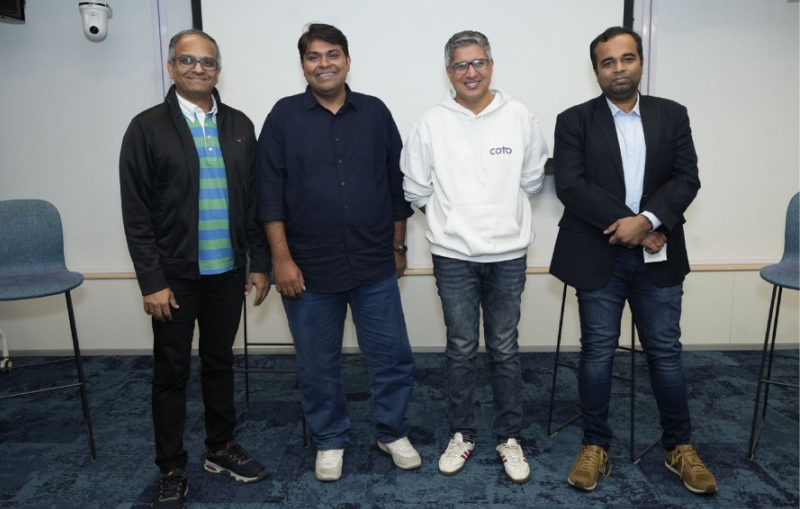
Panel (Mumbai): Anoop N Menon (Principal, Chiratae Ventures) moderating, with Suyash Katyayani (Co-Founder & CTO, Purplle), Tarun Katial (Founder & CEO, coto), and Sneh Vaswani (Co-Founder & CEO, Miko).
Here is what’s actually changing – and what’s actually defensible.
Beauty & Commerce: The Workflow Is the Product, Not the Prompt
Anyone can type a prompt into an image model and get a banner. The question Purplle’s Suyash Katyayani posed is the one that actually matters: can you get a banner that reliably delivers a 1.5% click-through rate? That gap – between generating something and generating something that performs – is where the moat lives. It isn’t the model. It’s the proprietary data loop and the domain workflow in which every step (market research, briefing, creative, formulation) gets 10x better with AI, but only because you own the hard-won knowledge of what “better” means in your category.
At Purplle this shows up in their industrial scale content engine: roughly 3,000 syndicated influencer pieces a month, with hit-rate and view counts predicted before anything goes live – driving on the order of 1.5 billion organic views a month.
The team, inspired by AlphaFold’s leap in predicting protein structure, designed a system to formulate private label products. Moving from data to idea to brief to shelf, and compressing a multi-year iteration cycle – provided you own the functional knowledge and the manufacturing loop to act on it
Suyash also made a sharp point around evolving behaviours of consumers in Bharat.
A consumer who once thought skincare meant “face wash and body lotion” now follows a creator’s ten-step Korean routine from a town like Nashik.
Metro and Bharat consumers differ in consideration, impulse, and wallet size – and it shows in how they browse and search. A platform that treats them identically is leaving both the loop and the moat on the table
He opined that not everything should run through an LLM. Tasks with clear features and tight feedback – a banner’s CTR, a unit test – are ideal. Judgment and strategy-heavy calls with sparse or unstructured data, where you greenlight one thing and kill another, are where you keep a human in the seat, and where traditional ML still wins when the features are well understood. Wherever you do lean on AI, the panel’s advice was to build in a layer of evaluations and validations so the model doesn’t drift.
Emotional Wellbeing: Meeting People Where Their Faith Already Is Therapy has never scaled. Good CBT and DBT practitioners are scarce; good deep-listening astrologers and Gita counsellors, scarcer still. The insight driving coto, as Tarun Katial framed it, is that you don’t scale therapy by cloning therapists — you scale it by meeting people inside the belief systems they already trust.
So the platform runs a continuum: from Vedic astrology, Gita, Hanuman, Ganesha, and tarot “cards” at one end, to science-led CBT and DBT at the other – roughly 150–200 sub-issues across some 25 modalities. Tellingly, a majority of younger users gravitate to tarot – a vocabulary they’ve picked up fluently, even though it was alien to the generation before them.
What makes this work is anonymity. Most users arrive as a number – “user 4689” – and are never given a name. Shame, identity, and the fear of being judged or betrayed keep people from being honest with the humans in their lives. An AI companion removes the core friction with therapy; it can be the 3am friend, available the instant someone is spiraling.
The economics tell an equally important story. A one-to-one human consult runs around $100 ARPU a month – premium, sparsely accessible and linearly scalable. The AI companion sits at $1–5, on compute cheap enough to recover the cost within a month or two.
Defensibility comes from a self-learning algorithm that compounds: the first 100,000 users teach the next million, and that million teaches the next five. And for genuine emotional emergencies, coto keeps a human in the loop, whose judgment is transcribed back into the system, training the model toward the day it can carry more of that weight on its own.
Learning & Parenting: The Form Factor Is the Strategy
Most consumer AI lives on a screen you already own. Miko’s bet, as Sneh Vaswani argued, is putting the intelligence inside a character-led physical companion, and that the engagement on the actual learning outcome will be many times higher – because there’s nowhere else to swipe.
That conviction shaped the whole company. The child is the consumer; the parent is the buyer – and both have to be satisfied. Hence, Miko measures interaction trajectories, milestones, and the social-emotional learning journey, not DAU/MAU. The parent sets the goals as more physical activity, stronger oral reading fluency – and the system steers the child there through a character it genuinely likes.
Sneh shared an analogy of why this actually works: a child ignores a parent’s daily instruction, but eats the spinach when they watch someone they admire eat it first.
Miko built its physical-AI platform ground-up – since 2015, well before “AI-first” was a slogan, because you cannot hand a child to a cloud model that might hallucinate. That insistence has since become an asset. Others product makers now want Miko’s intelligence layer inside their own form factors, and the technology is entering classrooms not as hardware but as a kid-safe “sovereign intelligence layer.” The analogy offered from the stage: Miko’s own device is the Pixel; the licensed intelligence layer is Android.
And the personalization frontier is genuinely new. Because the device carries the full context of a child, it can take on the persona of that child’s favourite character — and grow up alongside them. Ideas that “sounded creepy in 2016,”, are arriving now that society, and on-device edge inference, have finally caught up.
We host these evenings because the best signal on where Consumer AI is going doesn’t come from research reports. It comes from operators years into building something hard, being honest about what’s working and what isn’t.
Mumbai gave us three things we’re still thinking about:
“The model is infrastructure – the moat is the proprietary loop you compound on top of it. Price is becoming a design choice, not a constraint, as AI collapses the cost of delivery. And in India, faith and form factor are strategy: you win by meeting one specific human exactly where they already are.”
This was the second edition. Bengaluru was where the series began – fashion, hardware, education, entertainment. From Mumbai we’re carrying the conversation to more cities, across health, gaming, travel, companionship and more — different operators, different sectors, the same honesty.
Write to us at anoop@chiratae.com / samarth@chiratae.com and follow along. We’re figuring this out too.