

The Consumer AI Inflection Point: Redefining how we Live, Learn & Play
Reflections from a panel discussion on Consumer AI
Author: Samarth Gudwala and Anoop N Menon
Bengaluru, February 2026
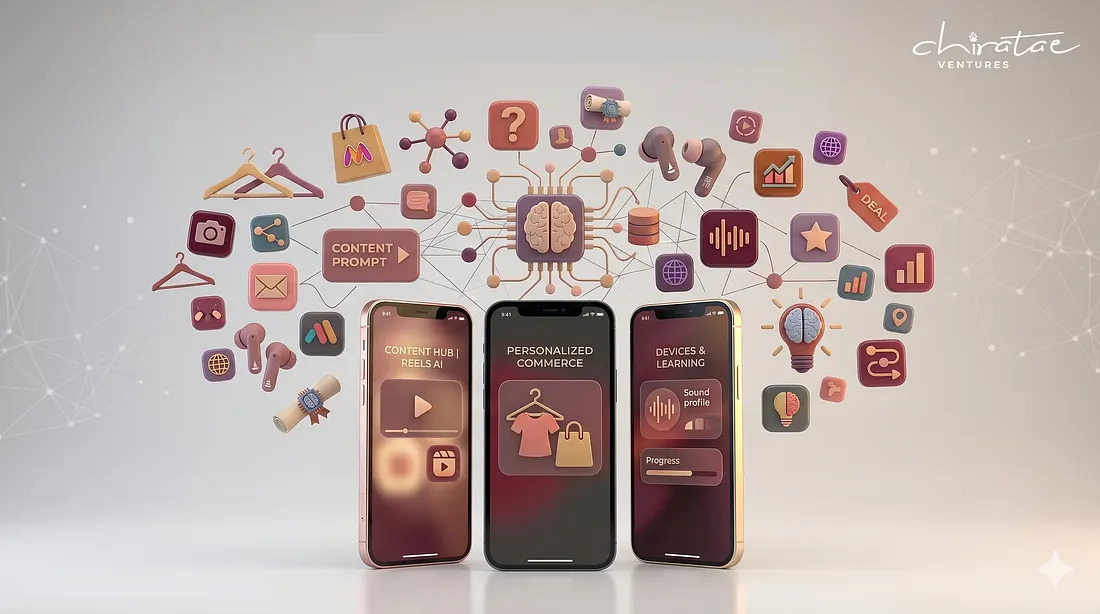
We tend to import global mental models. AI-native means Y Combinator. Consumer AI means ChatGPT wrappers. The real opportunity is in San Francisco, and India will catch up eventually.
A panel we hosted in Bengaluru last February – featuring operators from fashion, hardware, education, and entertainment – made one thing unmistakably clear: India isn’t catching up. It’s running a different race entirely.
Here is what is actually changing, sector by sector.
Fashion and Commerce: Attention Is the Scarce Resource, Not the Catalogue
Indian fashion e-commerce has spent a decade building toward personalisation. The arrival of GenAI has not changed the destination, at least not so far – it has sharpened the stakes considerably. The most significant shift is not what AI can do; it is what consumers now expect. Attention spans on mobile commerce are brutally short. A WhatsApp notification can pull a user out mid-browse. The platform that earns a return visit is not the one with the deepest catalogue – it is the one that has eliminated the cognitive overhead of discovery.
Conversational shopping – understanding occasion, context, and preference in natural language – is the most promising direction. But the real test is calibration: an AI-powered discovery experience has to feel native, not bolted on. And, voice has not cracked commerce, yet. Visual browsing wins on cognitive load; scrolling and tapping is genuinely lower effort than speaking and waiting. Even among vernacular users on platforms built specifically for them, the thumb beat the voice (Indian customers struggle with articulation of tasks). Image search is growing. Voice remains largely a customer support input for now.
Platform moats in fashion are shifting as a result. Catalogue depth is increasingly replicable. The emerging moat is the feedback loop between user interaction and model improvement – the deeper a platform’s understanding of how a specific user’s taste evolves over time, the harder it becomes to displace.
Hardware: The AI Is moving off the Cloud and onto the Device
Consumer hardware is undergoing a more fundamental transition than most consumer tech categories, because the site of AI computation is moving. Real-time ambient noise cancellation on a call, sensor fusion on a smartwatch, recovery analysis on a ring – these decisions need to happen in milliseconds, on-device. This is not merely a technical shift; it is a product design philosophy with direct consequences for the consumer experience.
Additionally, what is distinctive about building AI hardware for India is the localisation challenge. Indian consumers are genuinely heterogeneous in what they expect from an agent – not just across languages, but across regions and cultures. Some users want one crisp answer. Others expect a thorough walkthrough. General-purpose voice models are entirely blind to this variation. The operators getting it right are building regional interaction data loops – feeding conversations back into the system to fine-tune responses. That corpus, accumulated conversation by conversation, is a moat that cannot be purchased.
Education: Personalised Learning is finally Economically Viable
Learning has always had a personalisation problem. The ideal – a tutor who knows your current level, your gaps, your pace – but this has historically been available only to those who could afford it.
AI has changed this structurally. A library of a hundred thousand video lessons becomes qualitatively different when an LLM can ingest those transcripts and construct a genuinely personalised learning path in real time. Cohorts going through AI-native practice loops – applying what they learn interactively, not just watching – are showing materially higher day-on-day retention.
A deeper insight for builders is that, carefully fine-tuned models have an emergent ability to pick up on regional lingo. Drop a few Bhojpuri words or write in a Marwari register – the model catches it. New age platforms are now feeding these cues back into the system, allowing it to respond to each user in the register “they speak”.
This draws a hard line: if your platform behaves identically for a Tier 1 English-speaking user and a first-generation smartphone user in Patna – you haven’t built for Bharat. You’ve built something that tolerates it.
Entertainment: AI is rebuilding the Content Supply Chain
Indian digital entertainment is in the middle of a supply-side disruption. The traditional OTT model – commission, film, post-produce, release – runs on timelines measured in months.
AI is compressing this from the inside out. Mobile-first content players are now going from concept to finished episode in under a month, with real-time viewer drop-off data feeding back into every creative decision – scene by scene, hook by hook.
The consumer behaviour insight driving this is stark. Indian mobile entertainment consumers, particularly on paywall platforms, are less forgiving of slow pacing content than any previous generation. The tolerance for a slow opening has shrunk to approximately the time it takes to swipe to a Reels feed. This elevates hook strategy to a first-order content problem – a strong story with a weak opening will lose to a moderate story with a compelling one.
AI’s role is to radically accelerate narrative iteration around: the opening, the pacing, the thumbnail. When completion rates move 2-3x by iterating on these variables faster than competitors, the advantage is real and measurable.

Left to right: Anoop N Menon (Principal @Chiratae Ventures), Lakshminarayan Swaminathan (Head of PM @Myntra), Shyam Vedantam (CPO @boAt), Gautam Pratap Singh (SVP – Business @Seekho), Pratik Anand (Co-Founder @Flick TV)
The companies building durable positions in Consumer AI in India are not the ones adopting AI most broadly. They are the ones that have identified a specific, friction-filled, high-frequency consumer behaviour – and rebuilt that experience around what AI now makes possible.
In fashion, it is the discovery moment for a user with an occasion and no time to browse.
In hardware, it is the on-device inference that makes a wearable feel genuinely useful rather than a data dashboard.
In education, it is the personalised learning loop that meets a non-English speaker where they actually are.
In entertainment, it is the content iteration speed that lets a lean team compete with a large one on the quality of the hook.
In hardware, it is the on-device inference that makes a wearable feel genuinely useful rather than a data dashboard.
In education, it is the personalised learning loop that meets a non-English speaker where they actually are.
In entertainment, it is the content iteration speed that lets a lean team compete with a large one on the quality of the hook.
The horizontal platforms have scale and model capability that no vertical player can match. But they cannot replicate the depth that the best vertical players build when they obsess over a single consumer problem long enough.
“That specificity – the precise understanding of how a particular user thinks, communicates, and decides in a particular context – is the most defensible thing you can build in Consumer AI right now.”
We host these evenings because the best signal on where Consumer AI is going doesn’t come from research reports. It comes from operators who are years into building something hard, being honest about what’s working and what isn’t.
Bengaluru gave us three things we’re still thinking about:
“Voice is not the interface unlock we assumed yet, the data corpus is the real moat, and Bharat will punish lazy localisation in ways that aren’t visible until it’s too late.”
“Voice is not the interface unlock we assumed yet, the data corpus is the real moat, and Bharat will punish lazy localisation in ways that aren’t visible until it’s too late.”
This was Edition 1. We took the conversation to Mumbai next – different operators, different sectors, same honesty. And we’re taking it to three more cities after that, across health, gaming, travel, companionship and more.
Write to us at anoop@chiratae.com / samarth@chiratae.com and follow along. We’re figuring this out too.